

Hawaiʻi’s Unofficial Bird
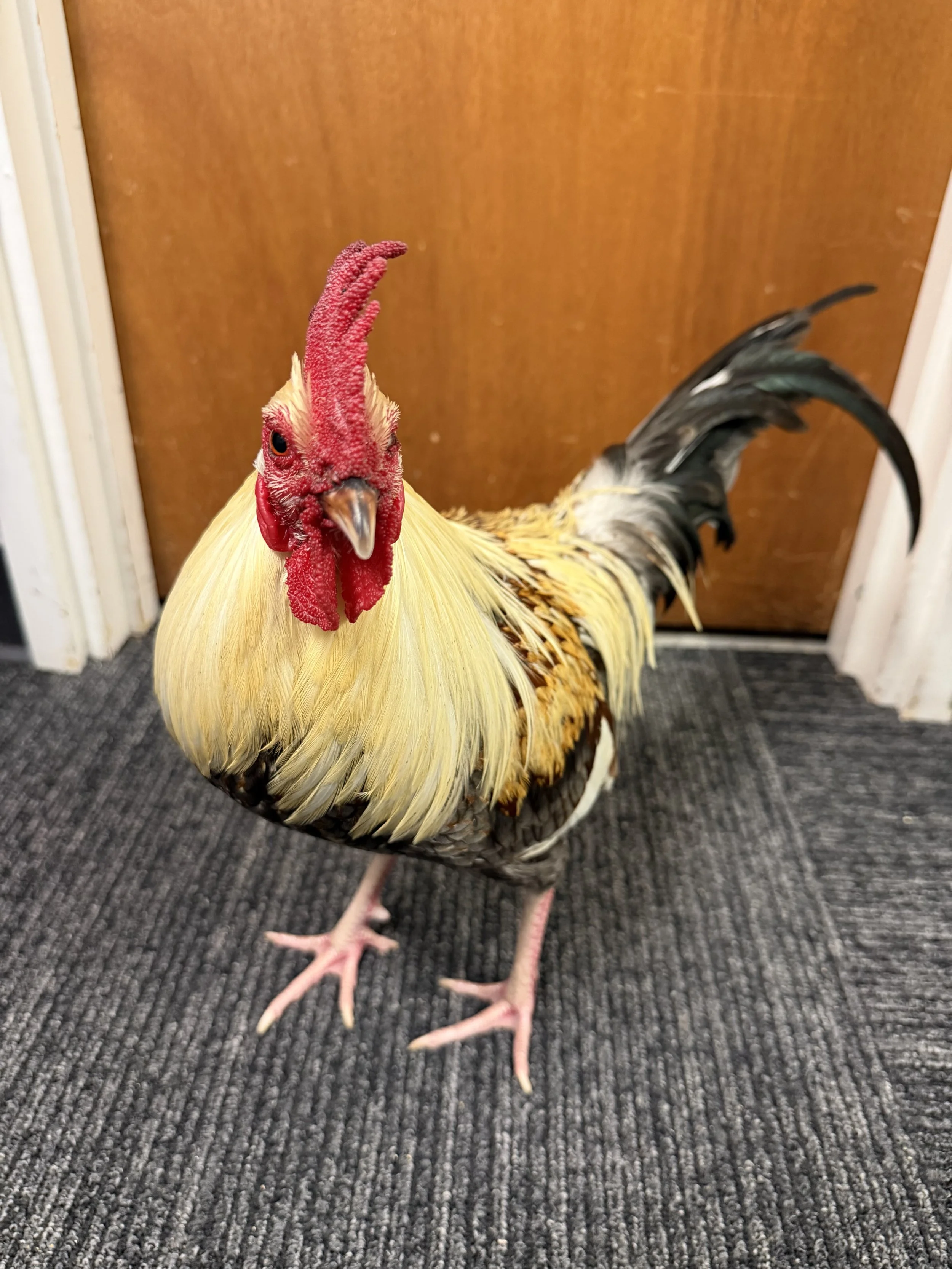
While nēnē are Hawaiʻi’s beloved official bird, the islands’ unofficial bird is the wild chicken. From the adorable cotton ball chicks to majestic roosters and maternal hens, wild chickens have become a part of everyday life in Hawaiʻi. Wherever you go, from the urban sprawl of the city to the grassy fields of the countryside, there’s wild chickens. This proliferation of poultry across the islands has not gone without notice. Heihei the rooster in Moana has fans across the globe. Central Pacific Bank has replaced Alex the Loyalty Dog with a rooster in its ads. Zippy’s “Where you stay?” icon on its webpage is a rooster. Reyn Spooner recently released its “Kauaʻi Alarm Cluck” Aloha shirt featuring rooster and hen prints. A Google search of “Hawaiʻi chicken” returns a plethora of stickers, mugs, posters, plushies, and garments. Most importantly, whimsical commerciality aside, the wild chicken is a culturally significant part of Native Hawaiian culture.
The wild jungle fowl, moa, was one of three food animals brought by Polynesian voyagers to the Hawaiian Islands. The feathers of the moa were used to adorn ʻulīʻulī and the kāhili of lower-ranking chiefs. moa feathers were also used on fishing lures. Kealoha Pisciotta, respected Native Hawaiian Cultural Practitioner eloquently states:
“In our traditions, the moa holds cultural and spiritual significance. They were revered and protected by the Akua and Ali’i and therefore respected by my people on many levels, including as messengers and, in some families, as ʻaumakua (ancestral guardians who guide and protect their families). In the Native Hawaiian worldview animals are not separate from us, they are part of our extended ‘ohana within the living system of the ‘āina.”
Moa, specifically the Red Jungle Fowl, have a long, shared history with kānaka maoli. Helumoa or “chicken scratch” in Waikīkī was home to many aliʻi. Helumoa was supposedly named after Kaʻauhelumoa, the mythical chicken who flew from Kaʻau Crater to the area we know as Helumoa today. After scratching the dirt at Kākuhihewa’s feet, the aliʻi ordered a coconut tree to be planted at the site where Kaʻauhelumoa scratched. The coconut tree later became a larger grove of trees, which was eventually named the King’s Grove. Other aliʻi including Māʻilikūkahi, Lāʻieloheloheikawai, Kamehameha V Lot Kapuāiwa, and Kamehameha Schools’ beloved founder Bernice Pauahi Bishop were all said to have lived in Helumoa at different times. Kākuhihewa’s encounter with Kaʻauhelumoa led to a historical place rich with connection to our aliʻi.
The wild chickens we see today are direct descendants of the moa brought by the Polynesian voyagers. Some are pure Red Jungle Fowl and some are a hybrid of released domesticated chickens and the Red Jungle Fowl. The important thing is that they are all moa. It is ironic that many of the people who revile and complain about the wild chickens are transplants to Hawaiʻi. They come for the surf, the sand, and the scenic hikes, and want to redefine the Hawaiian islands in their idyllic postcard image. They fail to recognize and understand that moa have more right to be here than they do. Moa are not an introduced pest like the Coconut Rhinoceros Beetle but rather living symbols of the Native Hawaiian culture that should be revered and honored.
