

Saving Cheesecake, Saving Them All
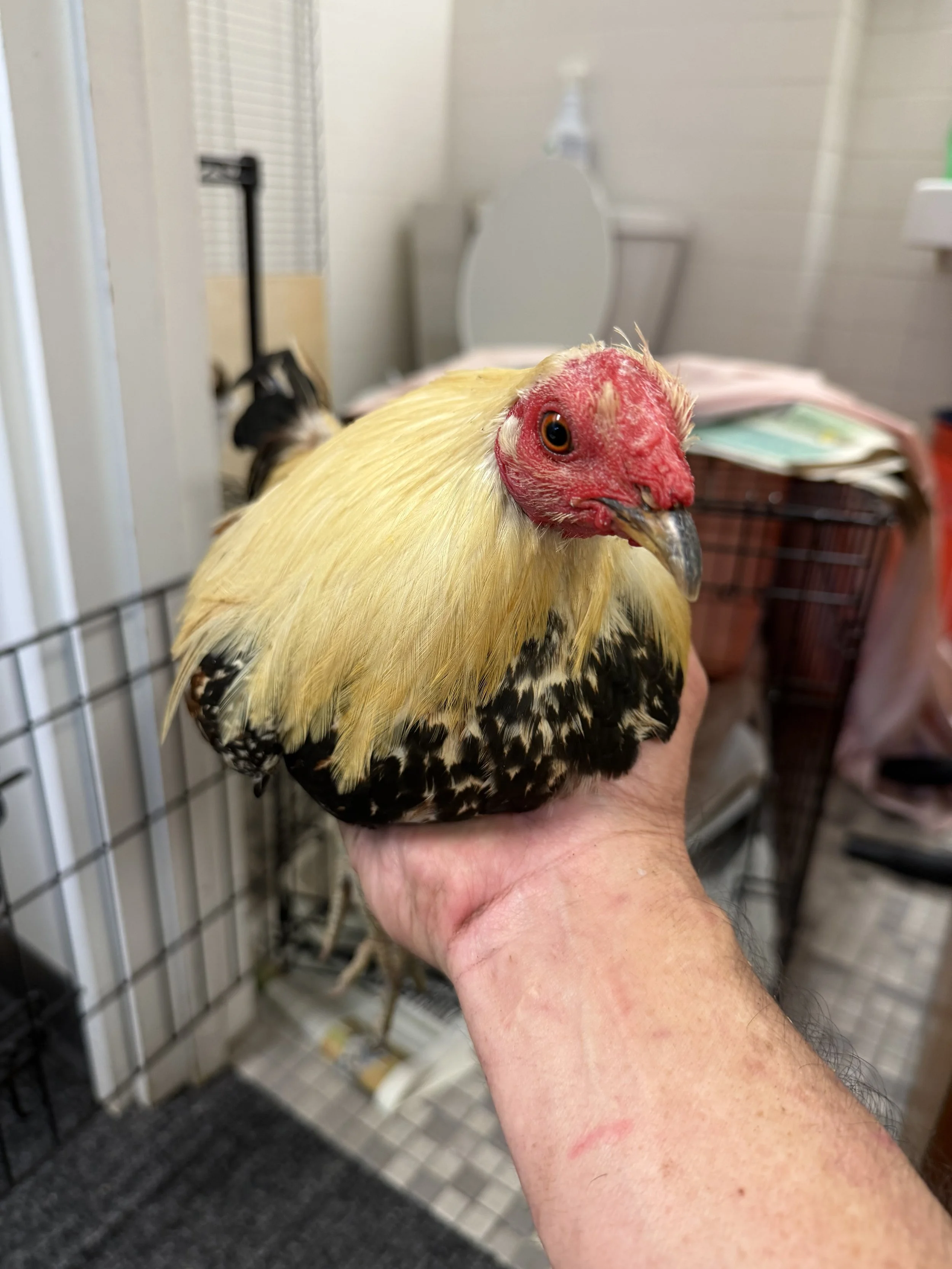
The hen dutifully prepared a nest of leaves, sticks, branches and feathers under a bush in Kapolei. For 21 days she sat on the 10 eggs until the peeping little balls of fluff hatched. One of the chicks was Cheesecake the rooster.
For almost two months, Cheesecake and his siblings followed their mother around. She taught them how to forage for food and water and where to roost at night. Cheesecake had the unfortunate lot in life of being born a wild rooster in Hawai‘i. As he grew from chick to cockerel to rooster, his plumage matured and he became a target for the “chicken boys.”
The “chicken boys” are all over the island. They grow up around chicken fighters and emulate them, badly. They usually range in groups on bikes or eBikes and spend hours after school and on weekends hunting down wild chickens, mostly roosters. They often use “bait roosters,” tethered with paracord or shoelaces to attract the wild roosters. The boys use the roosters for street fights in parking lots and parks. They kill or torture hens and chicks simply because they can. Chickens are housed in plastic bins, cardboard boxes, or even stuffed under traffic cones at night. These boys, ranging from 5-year olds to teenagers, commit atrocious acts of animal cruelty and subject the chickens to physical and psychological abuse with no remorse.
By the time Cheesecake developed his adult plumage he had joined a flock of other wild chickens. He and his flock mates spent their days eating, scratching, roosting, and just being chickens. The boys had already targeted Cheesecake. The boys surrounded the flock. Cheesecake tried to run but they eventually cornered him and grabbed him, yanking his leg, pulling out clumps of feathers. Roosters are often injured during the boys’ capture attempts. Leg injuries – sprains, fractures – commonly occur when legs are grabbed or string nooses are used to snare roosters. Tail feathers are ripped out and wings are broken during the rough grabs and tackles. Cheesecake wasn’t a big rooster, far too small to be a fighter at the organized derbies, but big enough for the boys to use in their street fights. A piece of string was tied tightly around his leg and he was dubbed, badly.
“Dubbing” involves cutting off the comb, wattles and earlobes of a rooster. Even under the best of conditions, using professional tools and medications, it’s a painful, torturous process. Chickens are sentient beings with complex nervous systems and can feel pain, both physically and emotionally. When they boys dubbed Cheesecake they restrained him and used a pair of scissors. No anesthesia, no medication, no empathy for Cheesecake’s suffering.
The boys took him back to their townhouse complex. Cheesecake was used in street fights and subjected to daily abuse. A neighbor (“L”) reported seeing the boys swinging him around like a pinata and throwing him to each other like a ball. The police were called several times but said they couldn’t do anything other than telling the boys to take the string off Cheesecake’s leg. The police wanted videos of the abuse, evidence of injuries and a witness to give a statement. L didn’t want to come forward. She had intervened before and been confronted by the boys’ parents. The parents defended and condoned the behavior of their children.
Currently, the acts of cruelty committed by the boys (and their cockfighter relatives) are misdemeanor offenses that are rarely prosecuted. Even when cockfighters are prosecuted, the penalties are fines, no jail time, no deterrent to continue what they’re doing. For juveniles, the “penalties” are even less. Juveniles are either placed on status or probation with no time in custody. With no real consequences and parents who support or turn a blind eye to the behaviors, the boys continue their acts of cruelty with no repercussions.
The abuse of Cheesecake went on for weeks. He wandered around the townhouse complex during the day and roosted on balconies at night. Chickens usually stay within 100 to 200 feet of their “coop” when they free-range and this instinct gave the boys daily access to Cheesecake. The boys caught Cheesecake, released him, and caught him again multiple times. L and her sister tried to catch him when the boys weren’t around but were unsuccessful. Out of desperation, L posted in multiple Facebook groups begging for help.
A Trooper’s rescuer saw L’s post. He contacted her and arranged a rescue attempt. The volunteer chased Cheesecake around the complex for over an hour. Understandably, Cheesecake panicked and ran. Finally, with the help of L, her sister, and a couple former chicken fighters, Cheesecake was netted. He screamed and fought of course, every catch up to that point had meant hours of torture, pain, and abuse, but this time it didn’t end that way. Cheesecake was gently wrapped in a towel, put in a carrier, and taken to safety. All rescuers know that moment when the chicken realizes that they are safe and that they will never be tortured again, when the fear and hurt in their eyes softens. That was Cheesecake’s moment. For the first time in weeks, he wasn’t in fear, he was safe.
Cheesecake was taken to Trooper’s Chicken Rescue’s farm facility for rehabilitation. He was taken care of by volunteers who treated his injuries, gave him love and affection, and told him “you’re home and you’ll never be hurt again.”
Every day there are posts asking for help with chickens who are sick, injured or in dangerous situations. Cheesecake is one of the hundreds of rescues conducted by Trooper’s Chicken Rescue. Many of these rescues are roosters, former fighters dumped by cockfighters, or wild roosters that have been maimed and injured by the chicken boys. Rescues and rehabilitation take time, money, and volunteers. Trooper’s is underfunded and understaffed. Volunteers do all that they can, but the need is overwhelming. Food, cages, materials, and medical supplies cost thousands of dollars a year. Land is needed to accommodate facilities for education, treatment, and care. Legislation is needed to increase penalties for cockfighting and animal cruelty to provide real, significant deterrents. Law enforcement and the humane societies must enforce the laws and stop turning a blind eye to the problem. Trooper’s needs donations, volunteers, and people who will contact their legislators to ask for support for land, funding, and stricter animal cruelty laws. Trooper’s can’t do it alone and the chickens can’t speak for themselves. We need everyone’s help to save as many chickens as possible from the horrific trauma they experience every day. Together we can give these animals the lives of peace, safety, and freedom they all deserve.
